Artificial intelligence for urban ecosystem restoration: reshaping social–ecological–technological interactions
npj Urban Sustainability
paper
journal article
How AI supports integrated urban ecosystem restoration by linking monitoring, simulation, and participatory processes within a social–ecological–technological systems framework.
Abstract
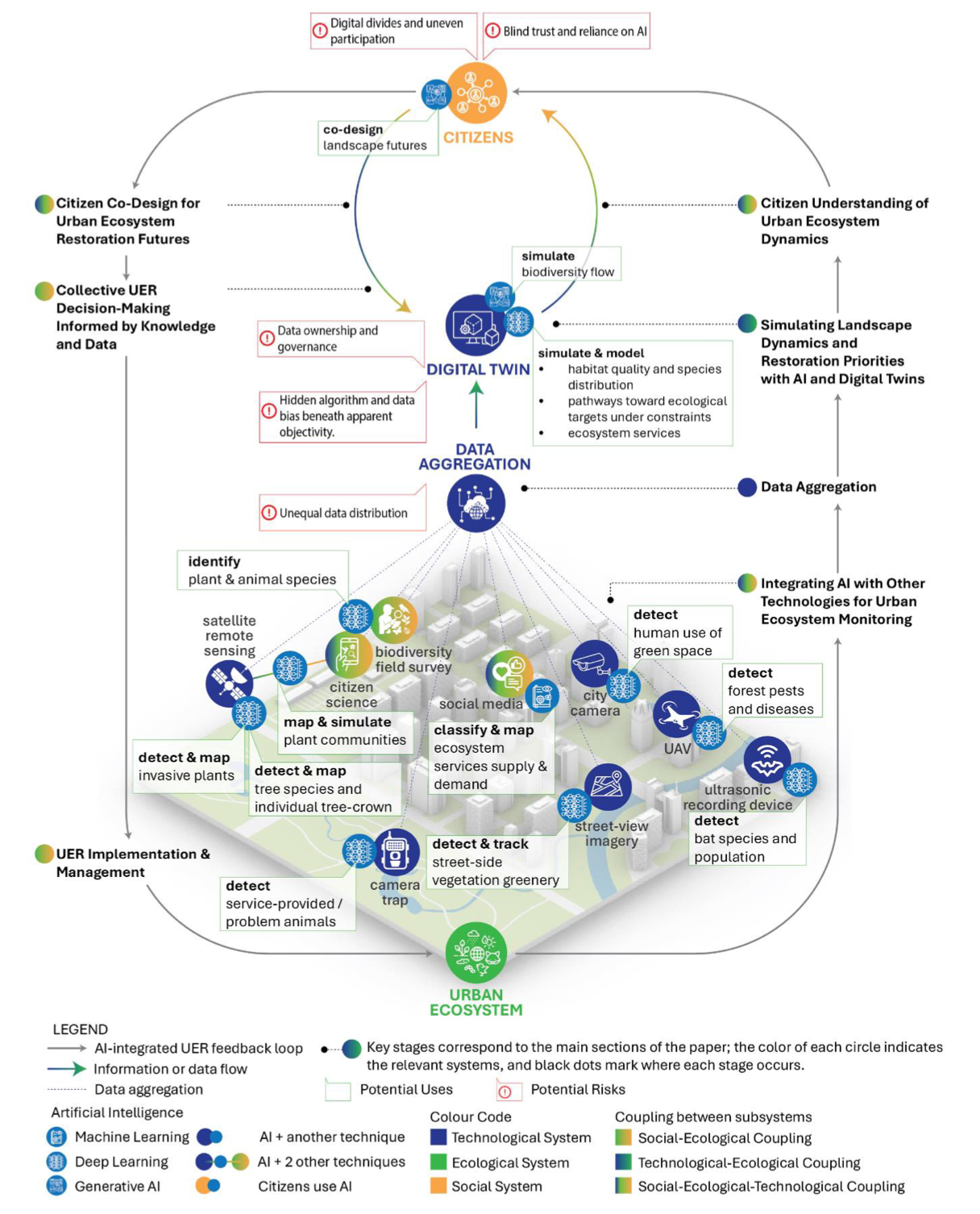
Ecosystem functioning enabled by urban ecosystem restoration (UER) contributes to sustainable cities. We examine how artificial intelligence (AI) supports integrated UER approaches by linking monitoring, simulation, and participatory processes within a social–ecological–technological systems framework, forming an AI-integrated UER feedback cycle. AI can contribute to social-ecological monitoring, multisource data integration, landscape simulation, citizen understanding, co-design, and adaptive management in UER under expert oversight and with attention to associated risks.
Links
Published paper on npj Urban Sustainability.
Citation
BibTeX citation:
@article{zhai2026,
  author = {Zhai, Xuezhu and Marcus Bach, Peter and Ghazoul, Jaboury and
    Casanelles Abella, Joan and Buchecker, Matthias and Giger Dray, Anne
    and Sun, Jiugeng and Kleinschroth, Fritz},
  publisher = {Springer Nature},
  title = {Artificial Intelligence for Urban Ecosystem Restoration:
    Reshaping Social–Ecological–Technological Interactions},
  journal = {npj Urban Sustainability},
  date = {2026-08-10},
  url = {https://www.nature.com/articles/s42949-026-00453-7},
  doi = {10.1038/s42949-026-00453-7},
  langid = {en}
}
For attribution, please cite this work as:
Zhai, Xuezhu, Peter Marcus Bach, Jaboury Ghazoul, et al. 2026.
“Artificial Intelligence for Urban Ecosystem Restoration:
Reshaping Social–Ecological–Technological Interactions.” Npj
Urban Sustainability, accepted, August 10. https://doi.org/10.1038/s42949-026-00453-7.